
WORKWEAR & MANUFACTURING
RFID Workwear and Uniform Tracking for Manufacturers
IntelTagRFID is a UHF-RFID textile tracking and laundry reconciliation platform. For workwear programmes it records which employee holds which garment, ages those holdings by day, and reconciles issues against returns every day. Anything outstanding past the configured window goes onto a chase list with the false positives already removed. Exit readers flag garments leaving site while still assigned to a named wearer, and the full industrial laundry cycle is reconciled daily in a format built to tolerate batched scanning.
Uniforms Issued to Named Employees Do Not Come Back
Garments accumulate in lockers, in cars and at home. They leave through the gate still assigned to somebody. Replacement orders go in because the store is empty, not because the fleet is worn out.
The industrial laundry cycle makes it worse. Scans arrive in batches, often days late and consolidated, so any manual reconciliation is comparing yesterday’s issue register against a delivery that has not been recorded yet. The counts never tie, and after a while nobody expects them to.
Ask a site manager who is holding what and the honest answer is usually a shrug and a spreadsheet that was accurate last quarter. That is not a discipline problem. It is a visibility problem, and it is solvable.
Four Questions a Uniform Programme Has to Answer
| The question | How IntelTagRFID answers it |
|---|---|
| Who is holding which garment? | A live per-wearer holding report, aged into day buckets, with per-garment drill-down and a pivot of the largest holders. |
| What has not come back? | Daily issue and return reconciliation splits outstanding garments into recently issued and overdue, cross-checked against current item locations so only garments genuinely still held stay flagged. |
| What left the site? | Exit readers list garments that left the premises while still assigned to a named wearer, grouped by description and by employee. |
| What needs replacing, and when? | Lifetime wash counts banded against a configured lifespan, rolled up by garment type and sorted by replacement priority. |
What the Platform Does
Name-Level Garment Accountability
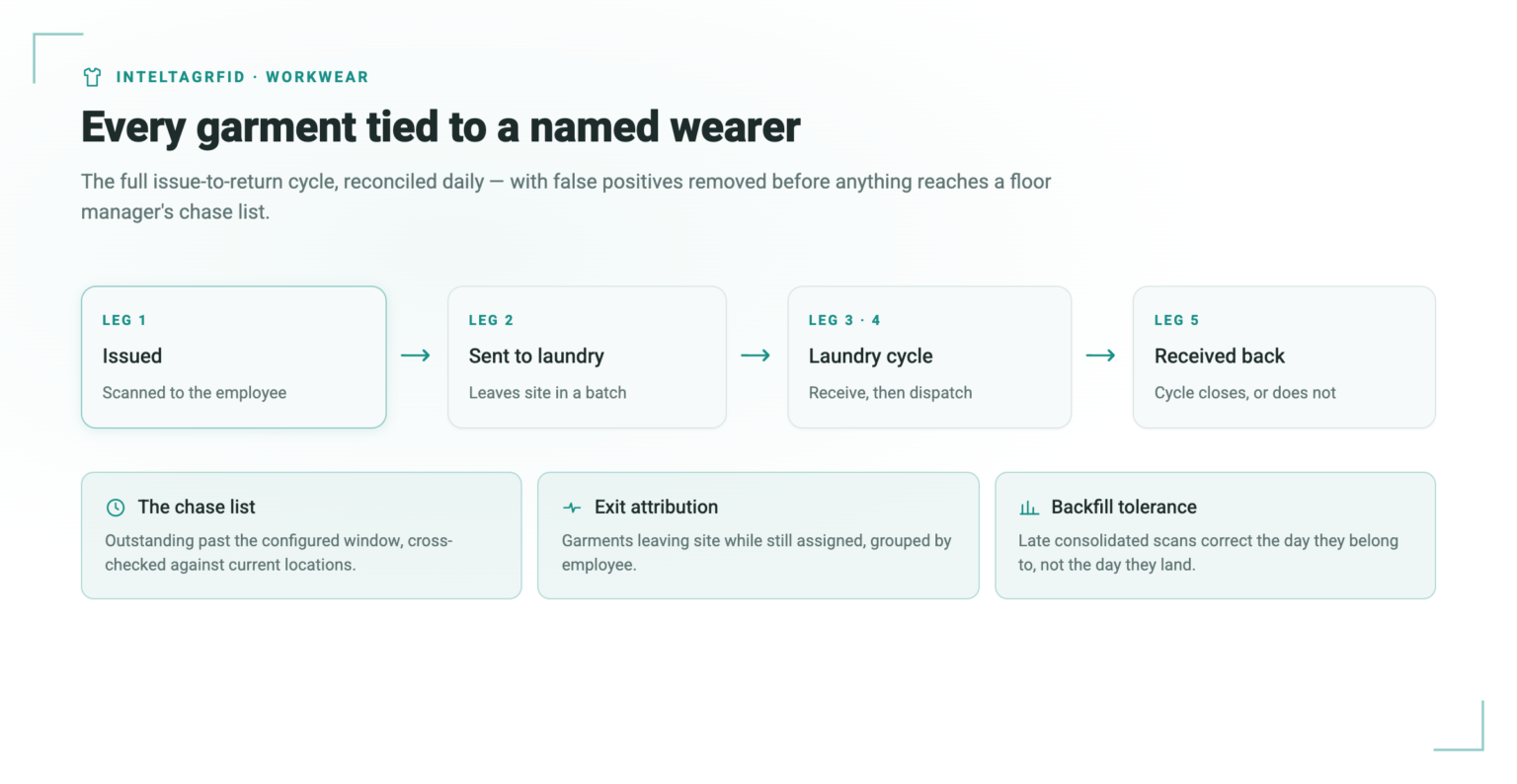
Every issue and return is scanned against the employee, producing a live holding report aged into day buckets with drill-down to the individual garment.
The part that makes it usable is the false-positive suppression. Overdue candidates are cross-checked against current item locations, so a garment already sitting at the laundry does not appear on somebody’s chase list. Floor managers get an exportable list of real outstanding items, which is the difference between a report that gets actioned and one that gets ignored.
Exit Events Tied to a Person
Doorway readers flag every garment whose last scan was an exit point, aged into day buckets and grouped both by garment type and by the wearer it was still assigned to.
The feature is enabled per site profile, so it can be switched on where it is wanted and left off where it is not. Worth being clear internally: the system tracks garments assigned to employees, not employees — a distinction that matters for how the programme is introduced on the floor.
The Full Cycle, Reconciled Daily
Daily reporting covers every leg — issued, sent to laundry, laundry receive, laundry dispatch, received back — with today’s position, month to date, and full-history monthly totals.
The reporting is deliberately batch-tolerant. A rolling history window is re-queried on every run, so late consolidated laundry scans backfill the days they belong to rather than distorting the day they arrived. This is the single design decision that makes industrial laundry data reconcile at all.
Replace Uniforms on Wear, Not Guesswork
Each garment’s lifetime wash count is banded against a configured lifespan into early, mid, due-soon and over-life bands, then rolled up by garment type and sorted by replacement priority.
Procurement plans from the over-life and due-soon columns instead of reordering when the store runs dry, which moves uniform spend from reactive to scheduled.
One Platform, Many Sites and Process Models
The dashboard serves multiple customer and site combinations from one system, with per-customer process profiles that adapt to each client’s actual cycle — different leg counts, different data flows — without forking code.
For a workwear rental operator running several client sites, that means new contracts onboard by configuration rather than by development.
Operational Matrix
Every figure below is a configured system setting, shown as a setting. They are defaults that are tuned per deployment, not performance guarantees.
| Operational challenge | Legacy constraint | What IntelTagRFID does | Configured setting |
|---|---|---|---|
| Uniform non-return | Manual issue registers, reconciled from memory | Per-employee holdings with a daily chase list and false positives removed | 24-hour split between recently issued and overdue (configured) |
| Garment loss at the gate | No attribution once an item leaves the premises | Exit reads matched to the wearer still holding the garment, grouped by employee | Aging bands from 7 days through to never-seen |
| Batched laundry scans | Counts never tie because scans arrive days late and consolidated | Rolling history window re-queried each run, backfilling earlier days automatically | 120-day history window (configured default) |
| Stale and likely-lost garments | Written off at stock-take with no explanation | Last-seen aging per cycle leg, by garment type | Follow-up list at over 90 days and never-seen |
| Replacement budgeting | Bulk purchasing without real-world wear or loss data | Wash-count banding by garment type in replacement-priority order | 100-wash default lifespan (configured) |
Proven in Live Operations
IntelTagRFID is deployed at a national food producer across two production sites — workwear cycle tracking, exit monitoring and daily cycle reporting — and at a services-group workwear operation running a full uniform rental lifecycle with wearer-level accountability.
The evidenced deployments are in food production and services-group workwear. Capability transfers to other industrial settings, and we would rather say that plainly than imply experience we do not have.

Frequently Asked Questions
Every garment issue and return is scanned against the employee, giving a live per-wearer holding report aged into day buckets with per-garment drill-down. It identifies staff sitting on un-returned garments without anyone having to run a manual audit.
Yes. A daily issue and return reconciliation splits outstanding garments into recently issued and overdue against a configured window, cross-checks overdue candidates against current item locations to eliminate false positives, and exports a chase list with employee, item, issue time and hours outstanding.
Yes. Doorway exit readers flag every garment whose last scan was an exit point, aged into day buckets and grouped both by garment type and by the wearer it was still assigned to. The feature is enabled per site profile.
Daily reports cover every leg of the cycle — issued, sent to laundry, laundry receive, laundry dispatch and received back — with today’s figures, month to date and full-history monthly totals. A rolling history window lets late, consolidated laundry scans backfill earlier days so batched industrial data still reconciles.
Every garment is bucketed by days since its last scan on each leg, by item type, with the longest-silent and never-seen buckets forming the follow-up list. Location views show where garments physically sit, including those still with a wearer.
Each garment’s lifetime wash count is banded against a configured lifespan into early, mid, due-soon and over-life bands, rolled up by garment type and sorted by replacement priority, so procurement plans from data rather than from an empty store.
Yes. The dashboard serves multiple customer and site combinations from one system, and per-customer process profiles adapt it to each client’s actual process model — different leg counts and data flows — without forking code.
Request a Workwear Accountability Review
Send us your issue and return records and we will show you where the garments are actually going — who is holding what, what left the gate, and what you are replacing early.
Latest blog posts
Awesome Blog
. 20/02
Garment Management Solution – RFID Technology Can Help Keep Foods Safe
Learn how RFID technology can help keep food safe through a garment management solution. Discover the…