

HEALTHCARE
RFID Linen and Scrub Tracking for Hospitals
IntelTagRFID is a UHF-RFID textile tracking and laundry reconciliation platform. For hospitals it audits the complete linen loop across four scanned legs — clean out of the laundry, clean into the hospital, dirty out of the hospital, dirty back into the laundry — with drill-down to delivery note, trolley and seal. It reports every garment’s last known location before loss across monitored doors, and delivers that report automatically each day.
Linen Disappears in the Gap Between Ward and Laundry
Hospital linen goes missing in both directions, and theatre scrubs leave through the doors. Everyone knows it happens. Almost nobody can say where.
The reason is that the record stops at the aggregate. A count tells you that four hundred items are unaccounted for this month. It does not tell you which leg of the cycle lost them, whether the shortfall opened on the way to the laundry or on the way back, or which door the scrubs went through. Without that, the conversation with the laundry provider is two sets of numbers and no evidence.
For a public-sector facility, this is an accountability problem on public assets before it is a budget problem.
Three Questions a Linen Contract Has to Answer
| The question | How IntelTagRFID answers it |
|---|---|
| Which leg of the cycle lost the linen? | The four-leg audit tracks clean out of the laundry, clean into the hospital, dirty out of the hospital and dirty back into the laundry, per day and per description. |
| Can we evidence it? | Drill-down includes delivery note, trolley and seal identifiers on every leg, exportable as a record that stands up in a contractual discussion. |
| Where did the scrubs go? | Every garment whose last recorded action was an exit scan is reported by door, with dedicated theatre-scrub views. |
What the Platform Does
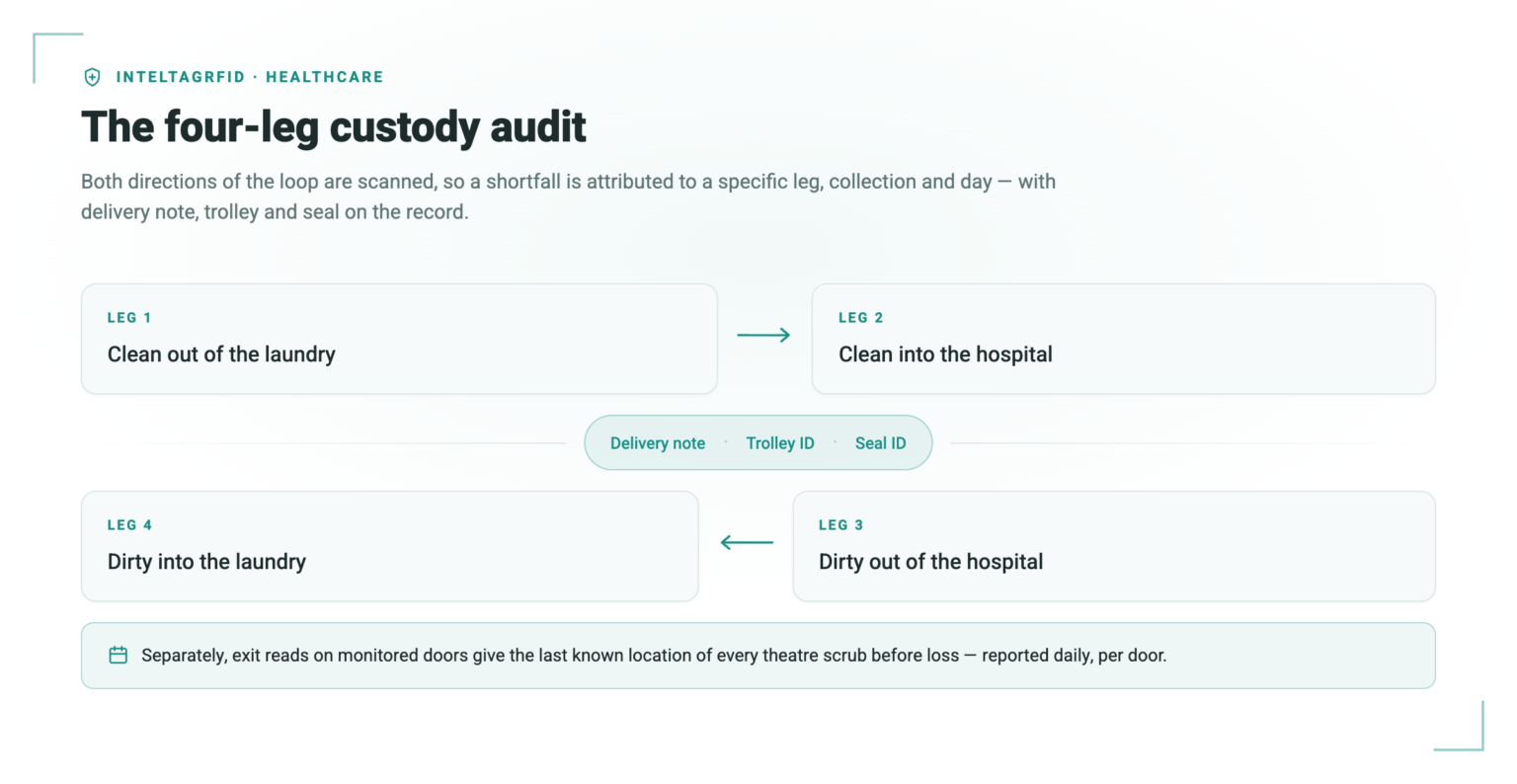
Four-Leg Custody Audit
The complete clean and dirty loop is tracked per day, per leg and per description, down to item code, delivery note, trolley and seal identifiers, with CSV export.
Because both directions are audited, a shortfall is attributed to a specific leg rather than argued over in aggregate. That is the difference between telling a laundry provider that linen is going missing and showing them which collection, on which day, came back short.
Last Location Before Loss
Exit readers on monitored doors record every tagged garment whose last action was an exit scan. Reporting breaks leakage down per door and per month, with dedicated views for theatre scrubs.
The value is specificity. Loss-management staff see which doors high-shrinkage clinical garments are leaving through, which turns a general suspicion into a place to put a control.
The Report Finds You
The loss-management workbook is regenerated and emailed automatically every day, with a summary of total tracked items, the top-leakage door and the scrub count.
This is one of the platform’s productionised scheduled jobs — it runs whether or not anyone remembers to ask for it, which is usually what determines whether a control survives past month three.
Per-Item Forensic Trail
Any single tag’s full history can be reconstructed chronologically across every event type, pairing each dispatch with its subsequent receive to show complete or broken cycles.
For a disputed item, that is the whole argument settled in one report.
Operational Matrix
Every figure below is a configured system setting, shown as a setting. They are defaults that are tuned per deployment, not performance guarantees.
| Operational challenge | Legacy constraint | What IntelTagRFID does | Configured setting |
|---|---|---|---|
| Linen lost between hospital and laundry | Counts reconciled manually, weeks after the fact | Four-leg cycle audit in both directions, per day and per leg | Per-day, per-leg, per-description drill-down |
| No evidence in a contractual dispute | Clipboard records with no item-level trail | Delivery note, trolley and seal identifiers recorded on every leg | Exportable audit record |
| Theatre scrubs leaving the building | Noticed only at stock-take, with no attribution | Exit reads capture the last known location before loss, per door | Dedicated theatre-scrub reporting |
| Reporting burden | Reports compiled by hand when somebody asks | Automated daily generation and delivery to named recipients | Scheduled daily email |
Proven in Live Operations
IntelTagRFID is deployed at a public hospital running a full four-leg linen cycle audit with one commercial laundry, and at a hospital and theatre property running daily theatre-scrub loss management with automated report delivery.
Our evidenced healthcare footprint is linen custody, loss management and audit. We deliberately do not make infection-control or hygiene-compliance claims, because that is not what the platform does.

Frequently Asked Questions
A four-leg audit covers the complete loop: clean linen out of the laundry, clean into the hospital, dirty out of the hospital, and dirty into the laundry — with per-day, per-leg and per-description drill-down including delivery note, trolley and seal identifiers, plus CSV export. It shows where linen goes missing in either direction.
Exit-monitor readers on monitored doors record every tagged garment whose last action was an exit scan, giving the last known location before loss. A daily automated report breaks leakage down per door and per month, with dedicated theatre-scrub views, so loss-management staff see exactly which doors clinical garments are leaving through.
Yes. The loss-management report is a productionised scheduled job: it regenerates the multi-tab exit and loss workbook and emails it daily with a summary of total tracked items, the top-leakage door and the scrub count.
The four-leg audit shows per-leg counts in both directions with delivery-note, trolley and seal detail, so a shortfall is attributed to a specific leg, collection and day rather than argued over in aggregate.
Yes. An audit report reconstructs the complete chronological lifecycle of a single tag across every event type, pairing each dispatch with its subsequent receive to show complete or broken cycles.
The same station-based model applies — tagging, dirty receive, exit monitors and handheld stock-take stations — quoted per station with a tag rental component and fixed-term monthly rental. Deployment runs from a scripted, service-managed install kit.
Request a Linen Custody Audit
Send us your linen cycle records and we will show you which leg is losing stock, and what the evidence looks like when you take it to your laundry provider.