
COMMERCIAL LAUNDRY
RFID Laundry Management Software for Commercial Laundries
IntelTagRFID is a UHF-RFID textile tracking and laundry reconciliation platform. It matches every item a laundry dispatches against what the customer site actually received, item by item and note by note, and classifies each one as on-note, off-note or no-dispatch-found. Inside the plant it verifies that every received item passed through a wash tunnel. Each customer gets a scoped view of their own stock from the same system, and lifetime wash counts drive condemnation and replacement planning. Count disputes are settled with item-level evidence rather than argument.
The Laundry Carries the Blame for Every Count It Cannot Disprove
A customer calls to say the delivery was short. Somebody checks a weight ticket, somebody else checks a cage count, and three weeks later the argument is still going because neither side can prove what was in the bag.
It is the same set of problems in every plant. Dirty returns do not match what was sent, and nobody can say whether the gap opened at collection, in transit or on the customer’s floor. Items skip a process step inside the plant and nobody notices until a complaint arrives. Linen gets condemned on appearance rather than evidence. And every customer wants their own numbers, which means somebody spends a day a month building reports by hand.
None of that is a counting problem. It is a proof problem. Aggregate counts tell you how much is missing; they cannot tell you which item was on which note, which leg lost it, or whether it was ever washed at all.
Four Questions Every Laundry Contract Has to Answer
| The question | How IntelTagRFID answers it |
|---|---|
| What did we actually deliver? | Every dispatched item is matched to the customer’s receive scan by item code and delivery note, then classified on-note, off-note or no-dispatch-found, with per-note conversion percentages and drill-down to the individual item. |
| Where did the variance open up? | Rolling send-versus-receive match ratios are calculated per leg, with dirty-versus-clean comparison, gap analysis by item type, and zero-scan-day detection where one side recorded nothing while the other recorded items. |
| Did every item actually go through the wash? | The item movement pipeline tracks flow from Received through the wash-tunnel bank to Packed and Dispatched, and a verification check confirms each received item was read at exactly one tunnel. |
| Which customer’s fleet is shrinking? | Per-customer tag accounting shows active, condemned and never-seen counts with month-by-month growth, so a fleet in decline is visible before the customer raises it. |
What the Platform Does
Referee Every Dispute With Data
Send-versus-receive match ratios are calculated on a rolling basis for each leg of the cycle. When a ratio drops below the configured alert floor, the system flags it and produces a findings report — plain-language root cause with numbered remediation actions, not a bare alert that something is wrong.
The zero-scan-day check is the one that usually settles it. Where one side of a handover recorded nothing while its partner recorded items, that day is surfaced directly, which turns a month-long argument into a specific date and a specific leg.
Prove the Plant Processed What It Received
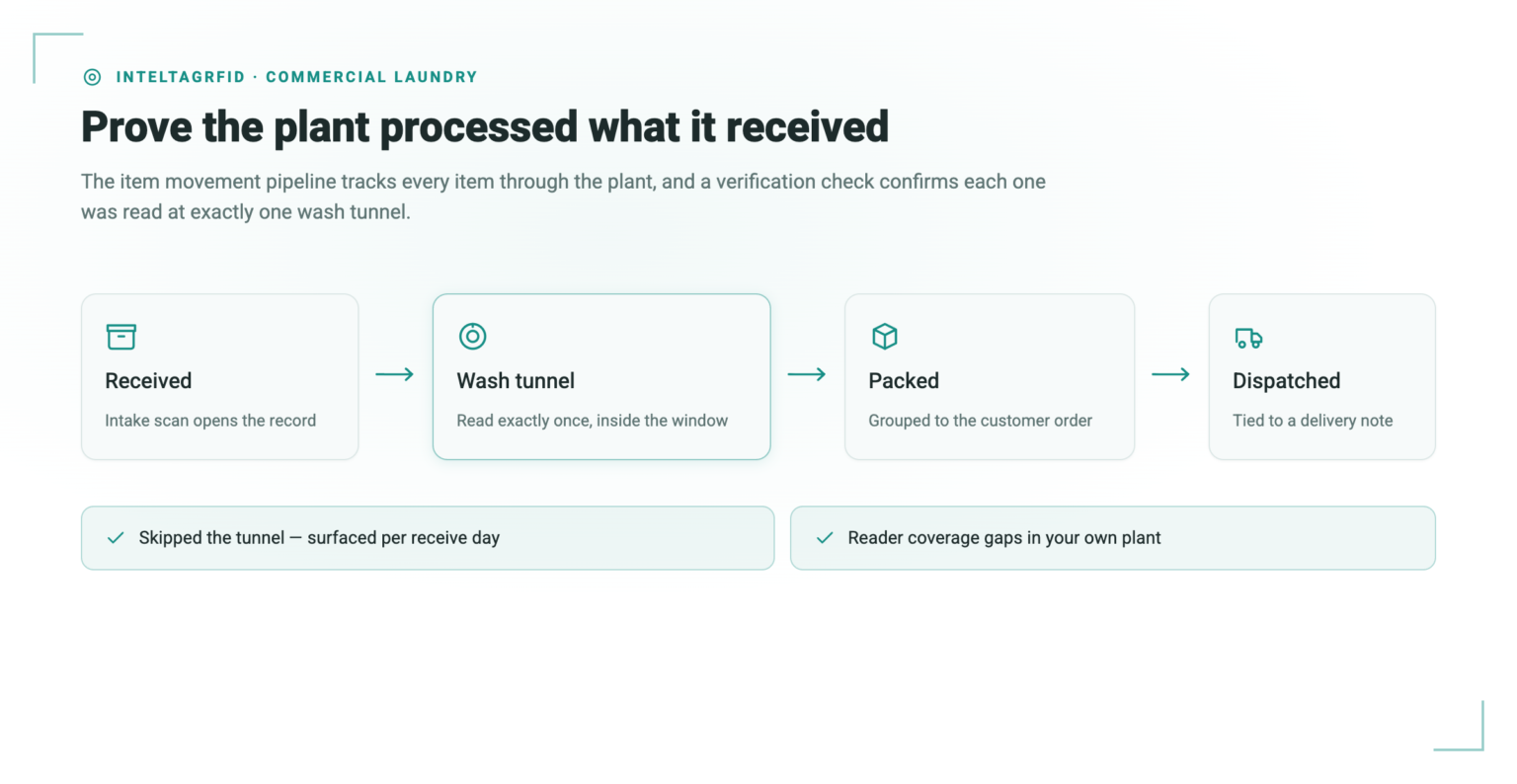
The item movement pipeline visualises the flow through the plant — Received, through the wash-tunnel bank, to Packed and Dispatched — with per-station daily counts, rolling averages and a day-by-station read matrix.
A verification card then checks that every received item was read at exactly one wash tunnel within the configured window, for each receive day. Items that skipped the process show up, and so do reader-coverage gaps in your own plant, which is usually the more useful finding.
Give Every Customer Their Own Dashboard
One system serves many customer and laundry combinations. Each customer logs in and sees only their own linen, with scoping enforced server-side on every drill-down rather than hidden in the interface.
New customers are onboarded by configuration — an identifier and a process profile — not by forking code. For laundries selling against competitors who still email spreadsheets, a live customer portal is a commercial differentiator as much as an operational one.
Manage Fleet Life and the Condemn Pile
Every tag accumulates a lifetime wash count. Items are tracked against a condemn threshold, and a watchlist flags stock approaching end of life so it can be physically inspected before it is written off.
Condemnation reporting splits the reason between over-washing and damage or loss, which is the distinction that tells you whether the problem is your process or your customer’s. A procurement forecast projects when each item type reaches threshold and how many units to reorder.
Operational Matrix
Every figure below is a configured system setting, shown as a setting. They are defaults that are tuned per deployment, not performance guarantees.
| Operational challenge | Legacy constraint | What IntelTagRFID does | Configured setting |
|---|---|---|---|
| Customer count disputes | Weight tickets and cage counts cannot identify which item was on which note | Item-level dispatch-to-receive matching per delivery note, with on-note / off-note / no-dispatch classification | 95% rolling match-ratio alert floor (configured default) |
| Wash-process integrity | No record of whether a received item ever reached a tunnel | Per-day verification that each received item was read at exactly one wash tunnel | 48-hour verification window (configured) |
| Condemnation and replacement | Stock condemned on appearance, replaced on budget cycle | Lifetime wash counts with an inspection watchlist and reason-split condemnation reporting | 80-wash condemn threshold, 75+ wash watchlist (configured defaults) |
| Mistyped delivery notes | A keying error reads as missing stock and starts a dispute | Off-note clustering surfaces the probable correct note with a confidence score | 90.0 note-accuracy floor for exception days (configured) |
| Per-customer reporting load | A day a month building reports by hand | Scoped customer dashboards plus scheduled report delivery by email | Automated daily and weekly schedules |
Proven in Live Operations
IntelTagRFID is deployed across multiple commercial laundries running multi-customer dashboards, in-plant movement pipelines and variance analytics — alongside the hotel, resort, hospital and food-production sites those laundries serve.
The platform is installed from versioned, scripted deployment kits, and new customer sites are added by configuration rather than custom development.
[Image slot — see the image brief. Replace this text widget with an Image widget, or set the section background, once the asset is in the Media Library.]
Frequently Asked Questions
Every dispatched item is matched item-by-item against the customer site’s receive scans by item code and delivery note, classifying each as on-note, off-note, or no-dispatch-found, with per-note conversion percentages and drill-down to individual items.
Rolling send-versus-receive match ratios are computed per leg, with dirty-versus-clean leg comparison, gap-by-item-type analysis and zero-scan-day detection — the case where one side scanned nothing while the other recorded items. The output is a findings report with a plain-language root cause and numbered remediation actions.
The item movement pipeline visualises plant flow from Received through the wash-tunnel bank to Packed and Dispatched, with per-station daily counts and a day-by-station read matrix. A verification card checks that every received item was read at exactly one wash tunnel within the configured window for each receive day, exposing skipped items and reader-coverage gaps.
Yes. One codebase serves many customer and laundry combinations; each customer logs in and sees only their own linen data, enforced by per-user scoping with server-side checks on every drill-down. New customers are onboarded by configuration — an identifier and a process profile — rather than by forking code.
Lifetime wash counts drive condemnation management. Items are tracked against a configured condemn threshold, a watchlist flags stock approaching end of life for physical inspection, and condemnation reporting shows monthly trends split by reason — over-washing versus damage or loss. A procurement forecast projects when each item type reaches threshold and how many to reorder.
An audit tool reconstructs the full chronological timeline of any single tag across every event type — dispatch, receive, in-plant movement, stock-take, exit, return and allocation — pairing dispatches with their subsequent receives to show complete or broken cycles.
Quoting is station-based. Equipment is priced per operational station across the plant — dirty receive, heat seal, item movement, rewash, mending, packaging, exit monitors and handhelds — with a tag rental component and fixed-term monthly rental. Quotes are available in ZAR, USD or EUR.
Request a Reconciliation Review
Send us a month of your dispatch and receive records and we will show you where the variance actually sits — which customer, which leg, which days. No obligation, and you keep the analysis either way.
Latest blog posts
Awesome Blog

. 08/05
Hospitality laundry and RFID
Explore the benefits of using RFID Linen and Laundry Management Solutions within the Hospitality Sector.