
HOSPITALITY
RFID Linen Tracking for Hotels and Resorts
IntelTagRFID is a UHF-RFID textile tracking and laundry reconciliation platform. Every towel, sheet, robe and uniform carries a laundry-proof tag, scanned in bulk at each handover between the property and the laundry. The platform reconciles what was sent against what came back, flags tagged items passing monitored exits, surfaces stock that has not been seen for weeks, and forecasts replacement from actual wash counts rather than from the budget cycle.
Nobody Can Prove Where the Linen Went
Linen is a high-volume, high-trust, low-visibility asset. Thousands of items move between guest rooms, floor stores, the dock and the laundry every day, and historically the only record has been a manual count on a clipboard.
So when the count comes up short, three parties point at each other. The hotel says housekeeping miscounted. The laundry says everything was returned in full. The housekeeping provider carries the reputational damage, and sometimes the cost, with no evidence to defend itself.
The numbers are not small. Industry research puts annual hotel linen loss at 10–20%, rising to 20–30% where tracking is poor (Xenia, Hotel Laundry Management Guide). On a mid-size property that is hundreds of thousands of rand a year in replacement cost — carried every year, and treated as unavoidable because nobody can see it.
The Four Questions Every Linen Contract Has to Answer
| The question | How IntelTagRFID answers it |
|---|---|
| Who is accountable for stock loss? | Every item carries a custody chain. The record shows who last held it and at which handover the count broke, so accountability is assigned on evidence rather than assumption. |
| Where is stock getting lost? | Each unaccounted item is traced to its last scanned zone — guest room, floor store, hotel dock, in transit, or the laundry. The leak becomes a location rather than a mystery. |
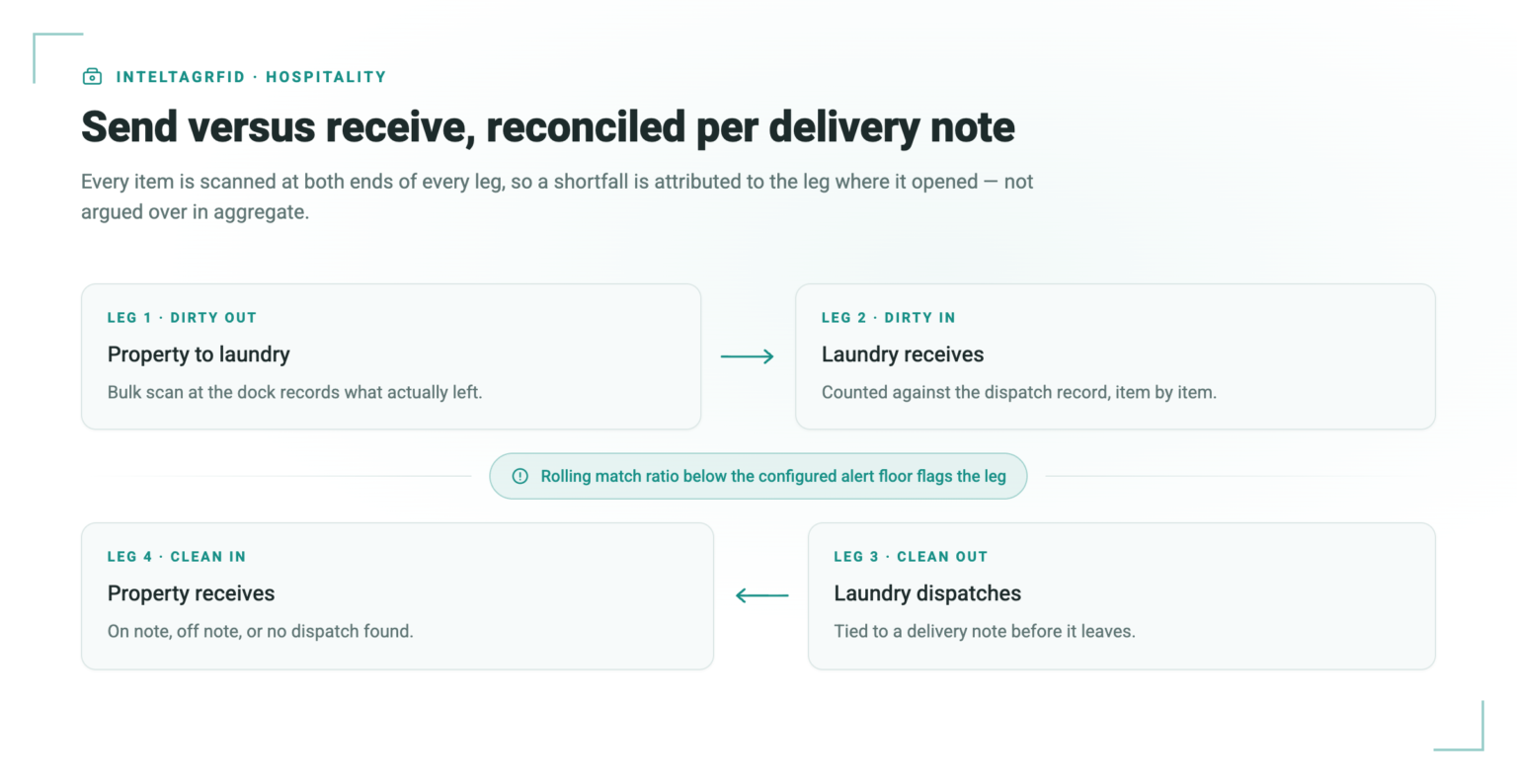
| Is it lost between the hotel and the laundry? | Send-versus-receive reconciliation compares what left the property against what arrived and returned. A shortfall in transit is flagged the same day, on the leg where it opened. |
| Is it being taken by staff or guests? | Guest-room items that never come back, and reads at monitored exit points, separate genuine removal from handover gaps that were never housekeeping’s fault. |
What the Platform Does
Every Delivery Note Reconciled to the Item
Each item the laundry dispatches is matched against what the property actually received, by item code and delivery note, and classified on-note, off-note or no-dispatch-found. The daily report shows conversion per note with drill-down to the individual item.
When off-note items cluster around a different note number, the dashboard surfaces the likely correct note with a confidence score — which separates a receiving operator’s keying error from genuinely missing stock, and stops the two being argued about as if they were the same thing.
Know What Left Through the Door
Doorway readers record every tagged item that passes, and reporting breaks it down per door, per hour and per item type, with age buckets and an exit timeline.
At one casino and entertainment property this runs as a daily workbook with per-door and per-hour cross-tabs — effectively an exit log organised for an operations manager rather than a security analyst.
Find the Linen You Already Own
Every item is bucketed by days since its last scan, from seven-day bands through to never-seen, split clean and dirty, and broken down by description and location. Par stock sitting idle in rooms and storerooms surfaces automatically, as does stock that has never been scanned at all.
Resort deployments also receive periodic stock age and wash reporting, including a depreciation and asset-valuation variant built for a finance team rather than a linen room.
Replace Linen on Evidence, Not Habit
Each tag accumulates a lifetime wash count, banded against a rated wash life. The rated life is a configurable threshold set per deployment, not a universal constant — towelling and flat linen are typically set differently.
An end-of-life forecast projects from recent wash rates when each item type will reach its threshold, flags items with no recent activity as stalled, and produces a procurement recommendation. For reference, published guidance puts hotel towel life at roughly 100–200 washes (RMT Hospitality).
Reports That Arrive Without a Login
Scheduled daily and weekly reconciliation reports are delivered by email and WhatsApp as Word, PDF or Excel documents. Monthly linen management reporting follows the same route.
Where AI-interpreted reporting is enabled, narrative summaries covering stock aging, usage and procurement are generated from aggregate figures — a readable management report rather than a data dump.
Operational Matrix
Every figure below is a configured system setting, shown as a setting. They are defaults that are tuned per deployment, not performance guarantees.
| Operational challenge | Legacy constraint | What IntelTagRFID does | Configured setting |
|---|---|---|---|
| Delivery disputes with the laundry | Hand counts reconciled against a delivery note weeks after the fact | Item-level matching of dispatch against receipt, per note, with on-note / off-note classification | 90.0 note-accuracy floor for exception days (configured) |
| Unverified loss in transit | No record of what left the property versus what returned | Send-versus-receive reconciliation across the full cycle, flagged on the leg where it opened | 95% rolling match-ratio alert floor (configured default) |
| Stock sitting unseen on property | Manual counts, out of date the moment they are finished | Last-seen aging bands by location and description, clean and dirty split | Follow-up list at over 90 days and never-seen |
| Towels and robes leaving the building | Noticed at stock-take, months later, with no attribution | Monitored exit reads reported per door, per hour and per item type | Per-door and per-hour reporting |
| Premature or late replacement | Replacement on appearance and budget cycle | Lifetime wash counts banded against rated life, with end-of-life forecasting | Rated wash life set per deployment (configured) |
Proven in Live Operations
IntelTagRFID is deployed at multiple luxury resorts and hotels, including Indian Ocean island resorts and a casino and entertainment property, running bulk RFID scanning, live dashboards, send-versus-receive reconciliation and automated daily reporting.
Deployment is non-invasive: tags are fitted to existing stock, readers are placed at floor stores, the dock and the laundry handover, and reporting begins without changing how housekeeping works.
Frequently Asked Questions
Every tagged item the laundry dispatches and every item the hotel receives is matched automatically by item code and delivery note, and classified as on-note, off-note, or no-dispatch-found. The daily report shows per-delivery-note conversion rates with drill-down to individual items, so billing and count disputes are settled with item-level evidence.
Yes. When off-note items cluster around a different note number, the dashboard surfaces a likely-wrong-note suggestion with a confidence percentage, flagging probable operator error at the receiving scan rather than genuine missing stock.
Yes. Doorway exit-monitor readers record every tagged item that passes, and reporting shows which items, item types and exit points are involved, with age buckets and an exit timeline. One casino and entertainment property receives a daily exit workbook with per-door, per-hour and per-item-type cross-tabs.
Every item is bucketed by days since its last RFID scan, in bands running from seven days up to never-seen, split by clean and dirty status and broken down by description and location. This surfaces par stock sitting in rooms, off-cycle storage and likely-lost linen automatically.
Each tag accumulates a lifetime wash count, banded against a rated wash life that is configured per deployment rather than fixed. An end-of-life forecast projects from recent wash rates when each item type will reach its threshold, flags items with no recent activity as stalled, and produces a procurement recommendation.
Yes. An audit report reconstructs the complete chronological lifecycle of a single tag across every event type — dispatch, receive, movement, stock-take, exit, return and allocation — pairing each dispatch with its subsequent receive to show complete or broken cycles.
Yes. Scheduled delivery includes daily Word reconciliation reports, automated weekly variance analysis by email, monthly linen management reports, and daily summaries and PDF reports over WhatsApp. Stakeholders receive reports without logging in.
Yes. The portal scopes each login by laundry, company, customer and site. Multi-property users switch properties from a dropdown, and isolation is enforced server-side on every drill-down rather than in the interface.
Request a Linen Loss Audit
Tell us your total linen value and room count and we will build the loss picture on your own numbers rather than an industry average. If it is worth doing we will show you why, and if it is not we will tell you that too.
Latest blog posts
Awesome Blog
. 27/09
Have More Control over Hotel Linen and Assets
RFID Linen and Asset Tracking Solutions; Radio-Frequency Identification is currently the best technology available for asset…

. 18/04
See through guest luggage without opening their bags with Discreet Security Exit Monitors
Discover how discreet security exit monitors can allow you to see through guest luggage without opening…

. 01/05
Why the Hospitality Sector Needs RFID
An informative blog about why the hospitality sector needs RFID linen and laundry management solutions –…
. 08/05
Hospitality laundry and RFID
Explore the benefits of using RFID Linen and Laundry Management Solutions within the Hospitality Sector.

. 15/05
How RFID Technology benefits hotels and Resorts
The Benefits of RFID Technology for Hotels and Holiday Resorts with IntelTag’s RFID Linen and Laundry…